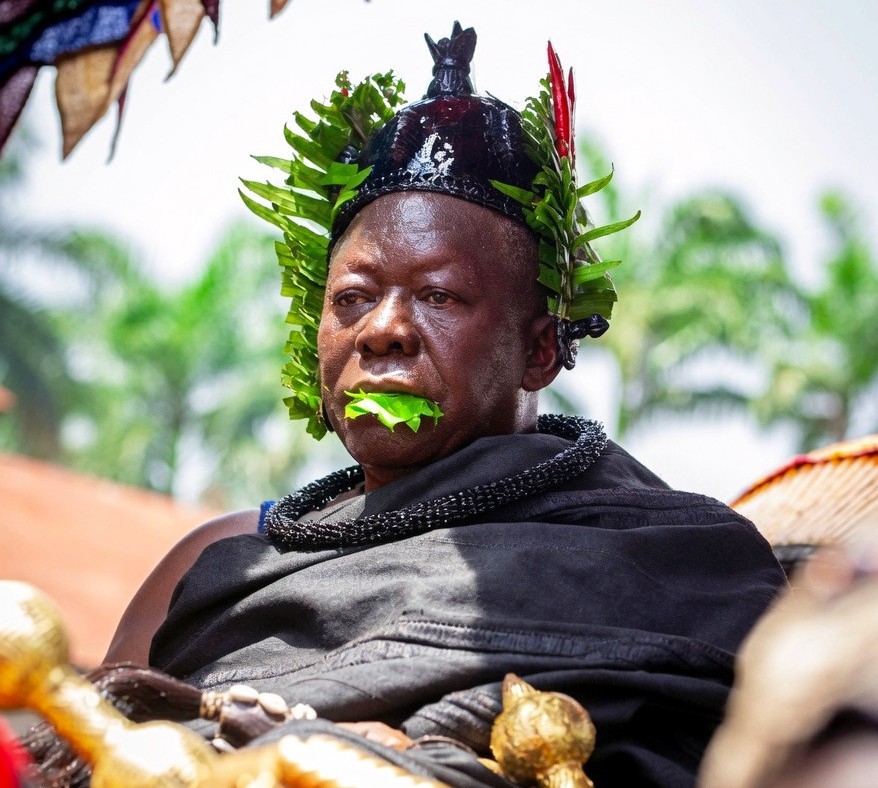
Otumfuo Osei Tutu II, the King of the Asantes, is typically seen with a green leaf in his mouth during some customary durbars or special rituals. The question "What is the essence of the Leaf in the King's mouth?" is frequently posed by those who do not understand this rite. Of course, if you are really curious, ask the appropriate individuals more questions about this peculiar incident.
During some traditional processions and particular durbars, the leaf or leaves placed in the mouth of Otumfuo Osei Tutu II, the Asantehene, are more than just cosmetic. In Asante kingship, they have profound historical and symbolic significance.
According to historical tales of Asante royal traditions, the king's appearance with green leaves in his mouth represents his connection to the ground or earth.
What the leaf represents:
Identification with the land: The simplest and most straightforward interpretation is that the leaves represent the Asantehene's relationship to the territory of Asanteman and the earth. Because the king has historically been linked to the safety and well-being of the people and the land, the symbolism is very important.
A sign of modesty and moderation: The leaf in the mouth can also be interpreted in the larger context of customary royal ceremonies, where the monarch is shown as a revered and strictly regulated royal figure rather than as a common person speaking freely. The Asantehene's speech and activities are purposefully limited in certain somber or ceremonial contexts.
Warfare and the warrior king: When the Asantehene is wearing traditional battle regalia, the leaf is particularly prominent. For instance, Otumfuo showed up to his 1999 enstoolment wearing a traditional combat garment called batakari kesie, with leaves sticking out of his lips.
Asantehene Installs New Asantehemaa Nana Ama Bonsu
This is a crucial distinction: the leaf itself should not be seen as a war sign by default. Instead, its significance stems from the larger ceremonial setting in which the Asantehene is portrayed as Asanteman's traditional protector and incarnation.
Custodian of Asanteman: The leaf relates to the traditional idea of the Asantehene as the guardian of the Asante people's institutions, customs, and territory. Although the king is frequently referred to as Asaase Wura ("Lord of the Land"), research on Asante royalty observes that his traditional duty is primarily related to preserving and maintaining the land rather than possessing it as personal property.
Otumfuo's holding the leaf in his mouth during a special durbar can be interpreted as a potent traditional statement:
Along with the Golden Stool, kente, gold jewelry, royal umbrellas, swords, drums, and other regalia, this sign is one of the numerous visual languages of Asante kingship. Depending on the specific ceremony, the precise meaning may change.
One thought on “What Does The Unique Leaf In Asantehene’s Mouth Mean?”