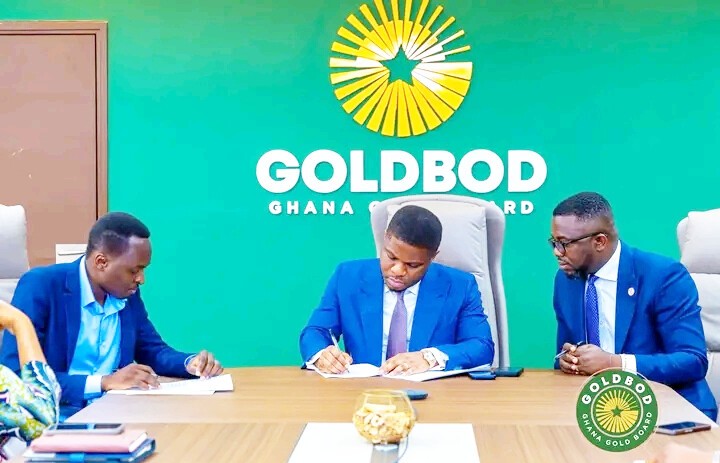
The Ghana Gold Board (GoldBod) has signed a partnership agreement with the Ghana Geological Survey Authority (GGSA) to conduct geological investigations across three mineralized areas, in a move aimed at establishing model small-scale mines across the country.
Signed on March 16, 2026, the agreement covers Phase 1 of the project, focusing on the Funsi, Atuna, and Bensere East areas in Ghana’s Upper West Region. GGSA will carry out the geological investigation services over a four-month period at a cost of GH₵27.5 million.
This data will help:
- Guide investment and development decisions for model small-scale mines.
- Improve transparency in mineral resource management.
- Enhance community involvement in the mining value chain.
- Support broader efforts to formalize small-scale mining, reduce environmental risks, and boost
The three sites are among 20 blocked-out mineralized zones released to GoldBod by the Minerals Commission of Ghana. The investigations will generate credible geological data on each area, which will in turn guide investment and development decisions, improve transparency in mineral resource management, and deepen community participation in the mining value chain.
GoldBod Rolls Out Monitored Trading Hubs In Key Mining Districts
The partnership falls under GoldBod’s Mining Support Program, designed to promote responsible and sustainable mining practices. Beyond data collection, the initiative is intended to support broader efforts to formalize small-scale mining, reduce environmental risks, and maximize Ghana’s national returns from its gold resources.
The agreement builds on earlier engagements between GoldBod, GGSA, the Minerals Commission, and the Ministry of Lands and Natural Resources, which had flagged geological mapping as a priority for sustainable mining development. It also forms part of GoldBod’s wider reform agenda — one that has already seen milestones including local refining agreements and the rollout of district-level gold buying centers.