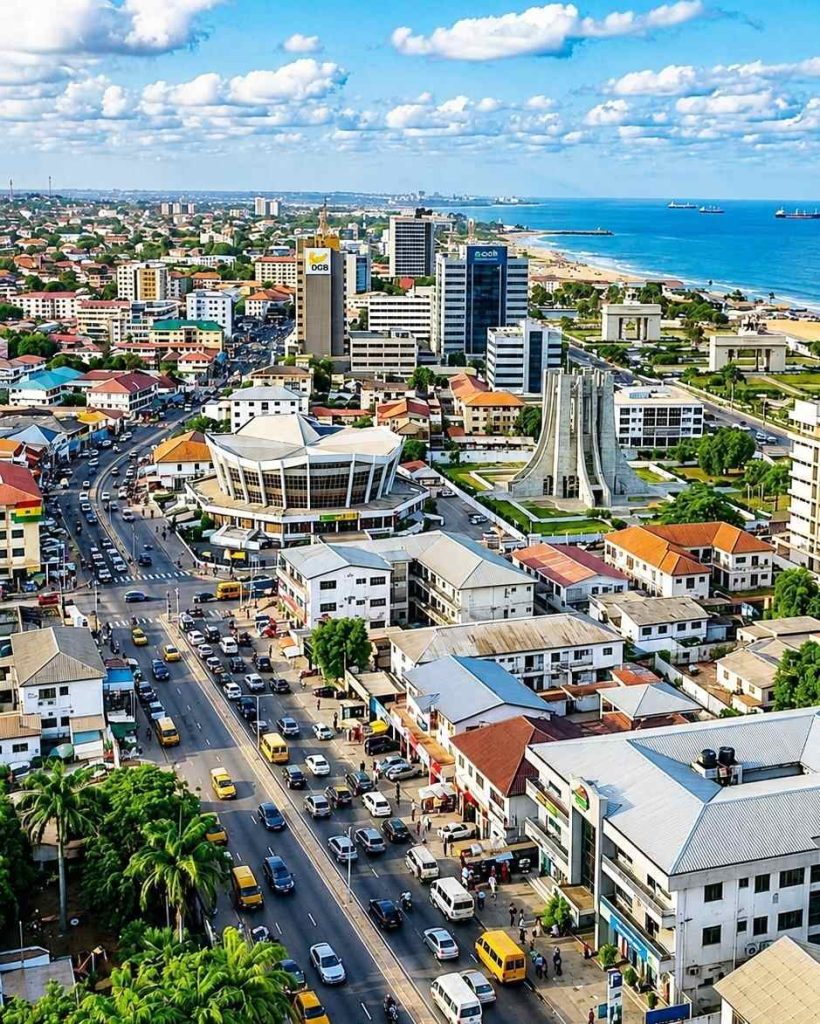
Accra is beautiful, energetic and full of possibilities. It is the political capital, economic centre and cultural heartbeat of Ghana. Yet beneath the bright lights, expanding skyline and growing number of businesses lies a difficult reality: for many ordinary people, living in Accra has become extraordinarily expensive.
The question therefore deserves to be asked loudly and honestly: as Accra continues to rank among the most expensive cities in the world for many residents and expatriates, what exactly is the Government of Ghana doing to make life more affordable for the people who call the city home?
This is not a new burden. It has been building for years. Accra was never designed for the population it carries today. Every morning, thousands of workers pour into the city from Madina, Kasoa, Adenta, Ashaley Botwe, Tema, Ashaiman, Spintex and countless surrounding communities. Roads become congested, public transport becomes uncomfortable, rents continue to rise, food prices remain challenging and commuting can consume a significant portion of a worker’s income.
For many young Ghanaians, the dream of living independently in the capital has become increasingly difficult.
A modest apartment can require a substantial advance payment. Transportation costs accumulate every day. Food, electricity, water, internet, school fees, healthcare and other necessities compete for the same limited salary.
And then there is the hidden cost of Accra: time.
A person may spend hours travelling to and from work every day. That is time that could have been spent with family, developing a business, studying, resting or simply living. Accra does not only take money from its residents. It also takes time.
But is Accra really “the most expensive city in the world”?
The description needs some caution.
There is no single global ranking that definitively makes Accra the world’s most expensive city for everyone. Different international surveys measure different things—some focus on expatriates, others on housing, consumer prices, transportation or the cost of maintaining a particular standard of living.
However, the underlying concern is very real. For many residents, the cost of living in Accra has risen faster than their ability to comfortably absorb those costs. That distinction matters. A city does not have to officially be declared the world’s most expensive before its residents begin struggling.
The Housing Crisis:
Perhaps nowhere is Accra’s affordability problem more visible than in housing. The demand for accommodation continues to grow as people move to the capital in search of employment, education, business opportunities and better services. But housing supply has not always expanded at the pace required.
The result is predictable: expensive rents, long distances between affordable accommodation and workplaces, overcrowding in some communities and a growing dependence on informal housing arrangements.
For young professionals, the situation can be particularly frustrating. Someone may secure a job in central Accra but discover that the salary is barely enough to cover rent and transportation. If employment increases but workers cannot afford decent accommodation close to their workplaces, then the city is creating opportunities while simultaneously making those opportunities harder to enjoy.
Government cannot solve Accra’s problems by focusing only on Accra. This is where the conversation must become bigger. The solution to Accra’s overcrowding is not simply to build more roads in Accra. Ghana needs stronger cities and economic centres outside Accra.
If quality jobs, hospitals, universities, industries, government services and major businesses are concentrated overwhelmingly in the capital, people will naturally continue moving towards Accra.
Affordable Housing In Ghana: The Big Promises, Real Projects, And Hard Truths
Government must therefore accelerate decentralisation.
Kumasi, Tamale, Takoradi, Cape Coast, Sunyani, Koforidua and other urban centres should not merely be described as regional capitals. They should become genuine economic alternatives.
Imagine a Ghana where a young graduate does not have to move to Accra to find meaningful employment.
Imagine a business owner being able to establish a thriving company in Tamale or Sunyani without feeling that Accra is the only place where the business can succeed. That would reduce pressure on the capital naturally.
What Should Government Be Doing?
The answer is not one massive project. Accra’s problems require a coordinated national strategy.
- Build affordable housing at scale
Government must work with private developers, financial institutions, pension funds and local authorities to create genuinely affordable housing.
Affordable housing should not simply mean cheaper houses for a small section of the population. It should mean homes that ordinary workers can realistically pay for without sacrificing most of their income.
- Transform public transportation
A reliable, affordable and efficient public transport system could dramatically reduce the financial pressure on households. Ghana needs to move beyond the idea that every family must eventually own a private vehicle. Well-connected buses, rail systems and other mass-transit solutions can reduce congestion, fuel expenditure and commuting time.
- Develop satellite cities and economic corridors
Accra should not carry Ghana’s economic ambitions alone. Government can deliberately create economic corridors linking Accra with surrounding communities while providing infrastructure that allows businesses and workers to operate efficiently beyond the traditional centre.
- Decentralise employment
Government agencies and private-sector incentives can encourage companies to establish operations outside Accra. Tax incentives, industrial parks, reliable electricity, digital infrastructure and good roads can make secondary cities attractive to investors.
- Control the cost of doing business
When businesses face high costs, those costs eventually reach consumers.>Electricity, transportation, rent, taxes, logistics and financing all influence the final price of goods and services. Government therefore needs policies that make production cheaper and more predictable.
- Strengthen urban planning
Accra’s expansion must be guided by serious long-term planning. Drainage, roads, waste management, water supply, sanitation, public spaces, schools, hospitals and transportation should be planned together rather than treated as separate problems. A city cannot continue expanding horizontally without asking whether its infrastructure can support that expansion.
The government has done some things—but the scale matters. It would be unfair to suggest that governments have done absolutely nothing.
Successive administrations have introduced road projects, transportation initiatives, housing programmes, infrastructure investments and urban-development policies.
The problem is that Accra’s growth has frequently outpaced the solutions.
That is the real challenge. Government should therefore move from reacting to problems to anticipating them. Accra’s population will continue changing. More people will seek jobs. More businesses will emerge. More housing will be required.
The question is whether government will grow its infrastructure and planning fast enough to match it. There is another dimension that must not be forgotten. Accra is not merely a collection of offices, shopping malls, luxury apartments and corporate headquarters. It is also the city of the teacher who wakes up before dawn. It is the city of the nurse travelling several kilometres to work.
It is the city of the trader carrying goods through crowded markets. It is the city of the security guard, cleaner, driver, artisan, food vendor, journalist, civil servant and young graduate trying to build a future. Yet many of them increasingly struggle to afford the very city they keep running.
Perhaps the most important question is:
“What kind of Accra do we want to build over the next 20 or 30 years?”
Do we want a capital where people spend half their income on housing and transportation? Do we want a city where traffic consumes hours of productive life? Do we want young people to believe that success requires moving into an increasingly expensive capital? Or do we want a modern, inclusive and affordable city where economic growth translates into a better quality of life?
Bus Stop In London Named After A Nigerian Nurse
The choice is ultimately about policy, planning and political will. Accra must remain a city of opportunity—not a city of survival Ghana cannot afford to allow Accra to become a place where people work simply to survive the cost of living. The capital should be a gateway to opportunity, not a financial trap.
Government must think beyond individual projects and develop a comprehensive urban strategy that connects housing, transportation, employment, infrastructure, decentralisation and economic policy.
Accra’s burden has existed for years.
It has been discussed in election campaigns, Parliament, boardrooms, homes and on social media. But the time has come to move from discussion to measurable action.
The fact is, a city can become richer without becoming more affordable.
And it can attract investment while quietly exhausting the people who live in it. Accra does not simply need more development. It needs smarter development—development that remembers the ordinary Ghanaian.
The future of Accra should not belong only to those who can afford it. It should belong to everyone.