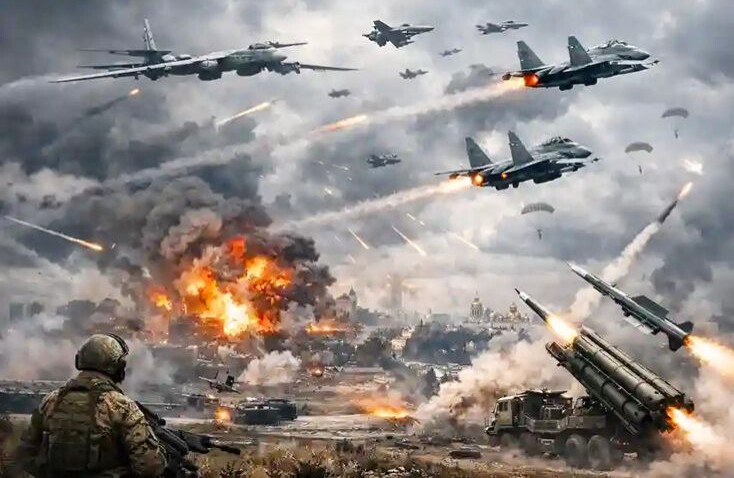
Iranian strikes on Dubai and the sudden closure of its airport have sent shockwaves through the Gulf, triggering a frantic exodus by the ultra-wealthy from Dubai, once again exposing the fragile line between glamour and geopolitics in the Middle East.
The glittering emirate—long celebrated as a playground for billionaires, influencers and millions of international visitors—has been on edge since drones and missiles, launched in retaliation for U.S. and Israeli strikes on Iran, damaged Dubai’s airport and hit several high-profile hotels and landmarks across the city.
Authorities in the United Arab Emirates confirmed on Monday that air defence systems were still intercepting incoming drones and missiles, as Abu Dhabi announced the closure of its embassy in Tehran amid an expanding regional war.
With commercial aviation crippled, those with means have been racing to escape by alternative routes. Some residents and visitors have opted for the four-and-a-half-hour drive to Oman, where disruption has been limited and Muscat airport remains open, albeit with delays.
Even there, flights to Europe are largely sold out until later this week. Private aviation has become the escape route of choice—but at a steep price. Demand has surged, aircraft availability has shrunk, and insurance concerns have made operators wary of flying in the region.
A Muscat-based brokerage said a short private jet flight to Istanbul on one of the smallest available aircraft now costs around €85,000—nearly triple the usual rate—while seats on charters to Moscow are selling for about €20,000 per person.
Several charter firms admitted they were struggling to deploy aircraft at all. One Europe-based operator described availability as “extremely thin,” with flights to the continent priced close to €90,000. Many aircraft owners, they said, were refusing to fly due to insurance restrictions and security fears—leaving vast demand chasing a handful of planes.
Others fleeing the UAE have taken an even longer gamble: a 10-hour drive across the desert to Riyadh, whose airport remains operational. Private security firms have been arranging convoys of SUVs to transport clients to the Saudi capital, where onward private flights are still possible—though punishingly expensive. Flights from Riyadh to Europe, brokers say, are now costing as much as $350,000.
The chaos has spilled into European politics. In Italy, a storm erupted after defence minister Guido Crosetto returned home on an Italian government aircraft while hundreds of other Italians remained stranded in Dubai.
Critics accused him of being in the emirate on holiday when the conflict began, prompting opposition calls for his resignation. In an apparent bid to ease the backlash, Crosetto returned alone, leaving his family behind, and said he paid for the flight himself. For ordinary travellers, there is little luxury—only waiting.
Confusion reigned on Monday as conflicting reports emerged about operations at Dubai and Abu Dhabi airports. Airlines including Emirates, flydubai and Etihad announced limited resumptions of service, mainly to repatriate stranded passengers.
Trump On Iran Conflict: No End Date, ‘Whatever It Takes’
Dubai’s tourism authorities have instructed hotels not to evict guests unable to leave due to mass cancellations, urging them to extend stays under original booking terms. Still, some visitors say reality on the ground is harsher. Russian tourists in particular have complained online of being told to pay extra or vacate their resorts.
“The receptionist told us it’s not their problem,” one woman said in a video circulating on Telegram. It’s an awful attitude toward people stranded in a foreign country.”
Beyond the city, the disruption has reached the seas. Thousands of tourists are reportedly stuck aboard cruise ships anchored off the Gulf coast, as ports across the region remain closed or restricted following Iranian drone attacks.
At least six major cruise liners, each carrying thousands of passengers, are currently confined near harbours, with guests told to stay on board—and in some cases inside their cabins—as the crisis unfolds.
For now, Dubai waits: its skies fractured, its runways silent, and its image as an untouchable global hub shaken by a war far beyond its shores.