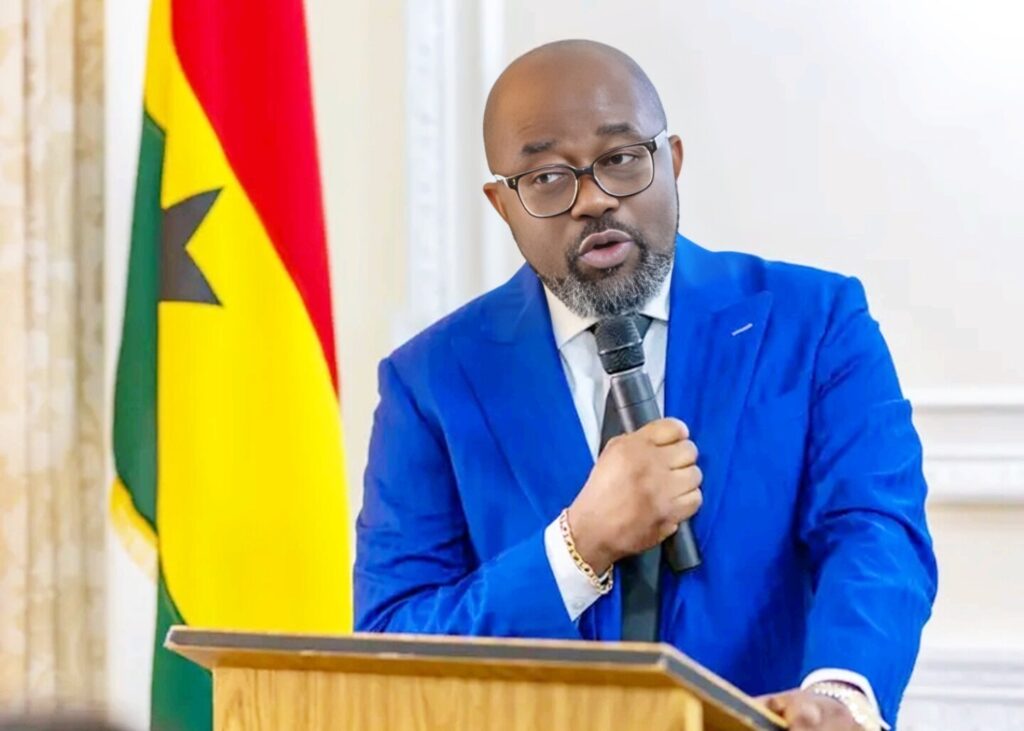
There are not many public figures in Ghana who would voluntarily place themselves in the same sentence as the President when it comes to criticism. Kurt Okraku is apparently one of them — and he is not complaining.
Speaking at the launch of the Ghana Football Association’s UK Talent Identification Programme, the GFA President offered a candid, and somewhat wry, assessment of his standing in the court of public opinion.
“I am not too sure that in our country, there are more than two people who are more criticised than my good self,” he said. “Maybe you take the President of the country out — the next most criticised person is Kurt Okraku.”
A Name on Every Lip
Okraku’s remarks were not entirely tongue-in-cheek. He pointed to the sheer volume of airtime that Ghanaian radio stations dedicate to football — and by extension, to him — as evidence of just how relentlessly his name circulates in the national conversation.
“Each radio station has dedicated airtime to football, and believe me, every second of the day, the name Kurt Okraku is mentioned,” he said.
It is a reality that comes with the territory of leading football administration in a country where the sport is not merely entertainment but something closer to a national religion. In Ghana, football debates are conducted with the intensity of political ones — and the GFA President, like any head of state, absorbs the heat regardless of who actually made the decision in question.
The Queiroz Squad Moment
Okraku illustrated the point with a recent and telling example. When Black Stars head coach Carlos Queiroz released his latest squad selection, the choices were his alone. Yet when Ghanaians took to social media to vent, it was not the Portuguese coach who bore the brunt.
“The Black Stars squad was released by head coach Carlos Queiroz. Go on social media and see who is attacked — it’s Kurt,” he noted, with the resigned air of a man who has long since stopped being surprised by it.
The timing of Okraku’s remarks is not insignificant. Ghana’s football moment is arriving fast. The Black Stars are in the final stages of preparation for the 2026 FIFA World Cup, with friendlies against Wales and Jamaica lined up as the team sharpens its readiness. In the tournament itself, Ghana has been drawn in a formidable Group L alongside England, Croatia, and Panama — a grouping that will demand the very best the country can produce.
Ghana Will Use 2026 World Cup To Showcase Its Arts
In that context, public scrutiny of the GFA and its president is only going to intensify. Every squad selection, every tactical decision, and every result between now and the World Cup will be dissected on radio stations, debated in barbershops, and litigated on social media — with Okraku’s name never far from the conversation.
Since taking office, Okraku has been a polarising figure. Supporters point to structural reforms, youth development initiatives, and the professionalisation of football administration under his watch. Critics, however, continue to measure his tenure by results on the pitch — and by that yardstick, the Black Stars have not always delivered the performances a passionate nation demands.
Yet Okraku himself appears to have arrived at a kind of equilibrium with the noise. He acknowledged the scrutiny openly, framed it as the unavoidable burden of leading football in a football-mad nation, and moved on.
In Ghana, criticism is not something a GFA President escapes. It is something he endures — and Kurt Okraku, it seems, has decided to wear it almost as a badge of honour.