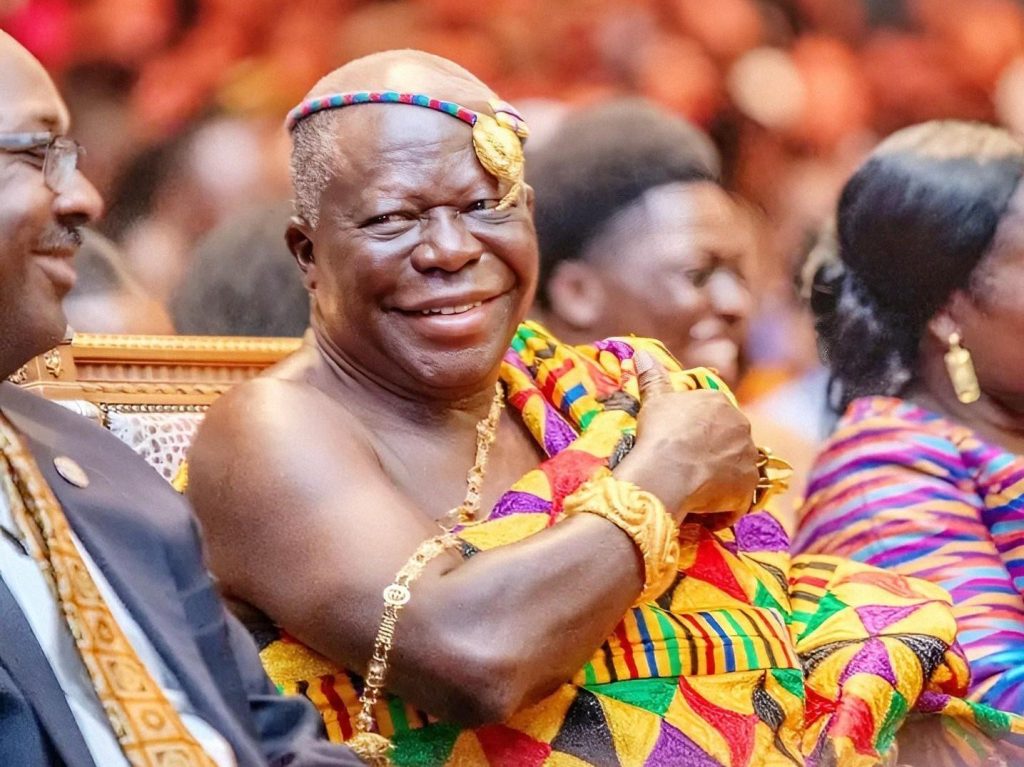
The Asantehene, Otumfuo Osei Tutu II, has been warmly received at Howard University in Washington, D.C., as part of activities marking the Millennium Excellence Awards Week.
Otumfuo arrived at the prestigious American university on Tuesday, August 25, where he was welcomed by Howard University President, Dr. Wayne A. I. Frederick; Provost, Dr. Anthony Wutoh; and Ghana’s Ambassador to the United States, Hon. Victor Smith.
The visit forms part of a series of engagements surrounding the Millennium Excellence Awards Week, which brings together prominent figures to celebrate leadership, excellence and achievements across various fields.
During his visit, the Asantehene delivered a speech and engaged in discussions with university officials, highlighting the importance of education, leadership, culture and the enduring connections between Ghana and the global community.
Otumfuo also held a private meeting with the university’s leadership and Ghana’s Ambassador to the United States ahead of his much-anticipated Royal Guest Lecture.
The engagement at Howard University further underscores the Asantehene’s growing international role in promoting Ghanaian heritage, education, leadership and cultural diplomacy.
His presence at the institution also provided an opportunity for meaningful dialogue between traditional leadership in Ghana and one of the United States’ most prominent historically Black universities.
The Royal Guest Lecture is expected to attract students, academics, diplomats and other distinguished guests as Otumfuo shares his perspectives on leadership, culture, education and issues of significance to Ghana and the wider global community.
Asantehene’s Remarks to the Royal Guest Lecture:
“Ceremonial visits, festivals, or symbolic gestures should not be the exclusive means of reestablishing ties between Africans and the worldwide Black diaspora. Beyond ceremonial homecoming, the relationship between Africa and the African diaspora needs to change”.
He went on to say that attending a festival, taking a picture at a historic location, or having an African name do not always foster a sense of community. Rather, “belonging is formed via connections, recognizing responsibility, and persistent participation,” he stated.
Otumfuo cited Sankofa’s Akan philosophy to argue that rather than merely staying rooted in the past, recovering history should assist people in creating a better future.
Additionally, the Asantehene contended that traditional leadership should not be seen as merely a ceremonial practice or an institution passed down from earlier times.
“Culture should not be limited to a ceremonial exhibition, nor should traditional leadership be seen primarily as an institution bequeathed from the past.”
“Chiefs must respond to challenges including unemployment, educational inequality, environmental degradation, land disputes, community conflicts, and the concerns of young people,” he stated, adding that traditional rulers have duties in areas like education, conflict resolution, environmental protection, community development, and youth welfare.
Otumfuo also talked about what he sees as a misperception of the Asante political structure. He pointed out that outsiders frequently ignore the philosophy that lies beneath obvious symbols like the Golden Stool, royal umbrellas, drums, languages, swords, processions, and gold jewelry.
The Asantehene said, the underlying values go beyond royal pomp and include accountability, trusteeship, and devotion to the people.
What Does The Unique Leaf In Asantehene’s Mouth Mean?
Additionally, he suggested a “Howard-Manhyia Dialogue,” which would bring academics and traditional leaders together to discuss issues related to African diaspora affairs, governance, and culture.
Without community, scholarship may become distant. Without scholarship, tradition is susceptible to distortion.
In areas like customary law, traditional constitutionalism, mediation, restorative justice, environmental stewardship, and cultural preservation, he proposed collaboration between Howard, Ghanaian universities, and traditional authority.
In the name of reestablishing ties with the diaspora, he issued a stern caution against commercializing African history and traditional authority.
“African family reconciliation must never turn into a marketplace where belonging is auctioned,” Otumfuo stated.
He went on to caution against the commercialization of traditional titles, the fabrication of historical claims to meet expectations, and the reduction of sacred institutions to tourist or spectacle.
He mentioned the legal systems:
“Law is essential, but it cannot establish a good society on its own.”
He maintained that moral conviction, civic duty, cultural values, trust, and restraint are all necessary for effective administration. He emphasized in particular that public resources should not be seen as chances for personal gain but rather as assets held in trust for society.
Additionally, the Asantehene cautioned traditional and political leaders against basing choices solely on short-term profits. He made the case that since leaders are just temporary guardians of institutions and resources, they have an obligation to preserve what still belongs to future generations.
The Asantehene’s visit to Howard University adds another notable chapter to his international engagements and the broader activities surrounding this year’s Millennium Excellence Awards Week.