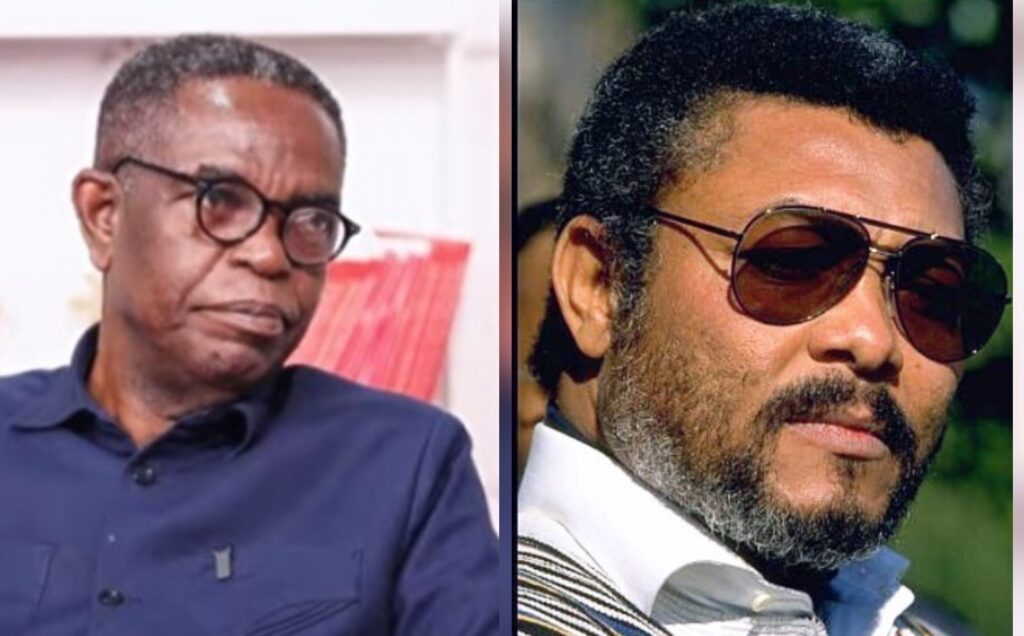
There are moments in history that no script could adequately prepare you for — and for veteran Ghanaian journalist Kwesi Pratt Jnr., one such moment came when he finally stood before Jerry John Rawlings, the man whose revolutionary government had thrown him behind bars nearly two dozen times.
Speaking during a recent interview with broadcaster Kafui Dey on March 23, 2026, the Managing Editor of The Insight newspaper recounted the encounter with the quiet gravity of a man who has long made peace with a painful past — though never forgotten it.
The backstory is as turbulent as Ghana’s modern political history itself. From the short, violent burst of the Armed Forces Revolutionary Council in 1979 to the prolonged grip of the Provisional National Defence Council that followed from 1981, Kwesi Pratt was a marked man. His journalism, his activism, his refusal to be silenced — all of it made him a target. He was arrested and detained without trial on approximately 18 separate occasions over the course of his career, with several stints stretching into months under Rawlings’ military rule during the 1980s.
The places he passed through read like a catalogue of suffering — Ussher Fort, Nsawam Prison, and others — where he endured maggot-infested conditions, shared cramped cells with convicted murderers, and at least once received chilling suggestions that he be sent somewhere to be quietly “finished.” These were not the inconveniences of a dissident. They were calculated attempts to break a man. Yet the man was not broken.
When the two finally came face to face — most likely in the post-1992 democratic era, by which point Rawlings had transitioned from military ruler to elected president and Pratt had cemented his reputation as one of Ghana’s most formidable public intellectuals — the moment carried the full weight of everything that had come before it. Rawlings, by Pratt’s account, greeted him with words that acknowledged their shared, bitter history: a nod, however understated, to all those jail times during the revolution.
Pratt’s retelling was reflective rather than vengeful — a striking choice for a man who, in other settings, has been far less charitable toward Rawlings’ legacy. He has elsewhere refused to offer the late former president the comfort of justification, pushing back sharply when Rawlings, in a 2020 interview, described the mass detentions as necessary measures taken “to contain a situation.” To Pratt, such reasoning was never sufficient — and never will be.
Presidential Charter Now Optional For Private Universities In Ghana
But in that first meeting, something more complex than anger filled the room. Two men shaped by the same era, on opposite ends of its violence, standing in the same space — one as the architect of the revolution, the other as a survivor of its excesses. No courtroom. No formal reckoning. Just history, breathing between them.
It is the kind of encounter that reminds you that Ghana’s revolutionary period was not merely a chapter in a textbook. For men like Kwesi Pratt Jnr., it was lived — in prison cells, in sleepless nights on remand, in the faces of fellow detainees, and ultimately, in the uncomfortable silences of a moment like that one.